What is KanjiPack?
KanjiPack is a kanji gacha game you play in your browser. Every pack holds ten kanji cards, drawn from the 17,816 characters that appear in Japanese and Chinese Wikipedia.
The more often a character shows up in Wikipedia articles, the easier it is to pull. You'll see 山 (mountain) and 人 (person) in almost every pack. The rarer a character is in real text, the rarer its card: 龘 and 靐 can take a long time to turn up. So rarity here isn't made up. It's how common the character actually is.
There's nothing to install and no account to make. Open the page and start opening packs, on your phone or your computer. Your progress stays in your own browser.
How to play KanjiPack
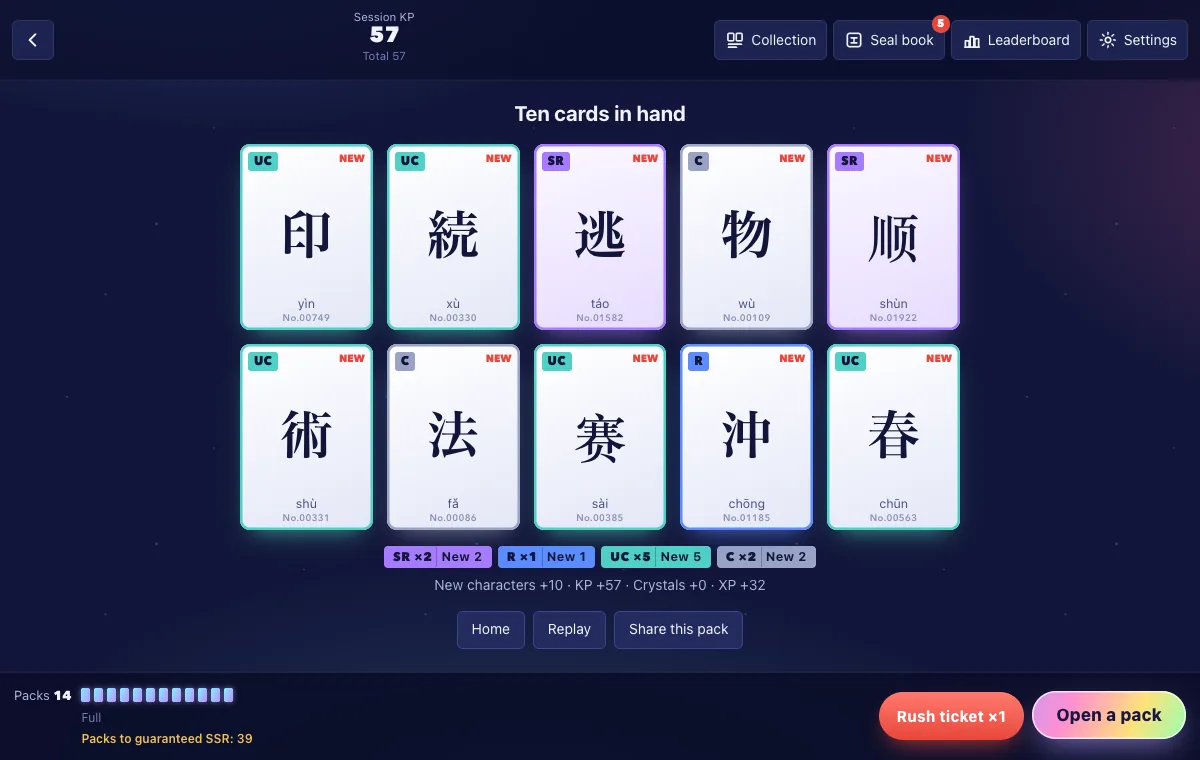
- Tap Open a pack, then tap the pack to tear it open.
- The ten cards flip one by one. Anything SSR or rarer gets its own spotlight.
- Pull a UR or LR, or get a 6% lucky break, and you start a Rush: bonus rounds of extra cards, up to 12, with your KP doubling every round.
- Duplicates turn into Crystals. Open an uncollected character in your Collection and you can trade Crystals for it.
- Packs refill at one per minute, up to 10, and your first visit each day fills them right up. Leveling up gives extra packs, and every friend who comes to play through your invite link gives you 10 more.
Use a mouse on a computer, your finger on a phone, or Tab and Enter on a keyboard. There's no ending. The goal is to fill your Collection and your Seal book, and leave your name on the leaderboards.
Where the seven rarity tiers come from
Every character is ranked by how many times it appears in Wikipedia article text. The further down the list, the rarer it is, split into seven tiers. These numbers are with both the Japanese and the Chinese character sets turned on:
| Rarity | Odds | Characters | Example |
|---|---|---|---|
| C | 50% | 260 | 山 |
| UC | 30% | 672 | 花 |
| R | 10% | 607 | 雪 |
| SR | 5% | 663 | 猫 |
| SSR | 3% | 946 | 蝶 |
| UR | 1.5% | 1,628 | 麒 |
| LR | 0.5% | 13,040 | 龘 |
LR cards get just 0.5% of the draws but cover more than 13,000 characters, so completing LR is the hardest thing in KanjiPack. If you turn on only Japanese kanji or only Chinese characters in Settings, rarity is re-ranked by that Wikipedia's character counts.
Glow packs, the pity counter, gold packs and the Character of the day
Your first pack each day is a glow pack with at least one SR. Go 39 packs without an SSR or better and the 40th is guaranteed to have one; the counter under your packs shows how many are left.
Your first visit each day adds a stamp to your Stamp card, and the days don't need to be in a row. Fill all 7 for a gold pack: it always has a UR and always starts a Rush.
There's also a Character of the day that turns up more often than usual. Drawing it counts toward the Star chaser achievement in your Seal book.
Boss fights: put your kanji to work
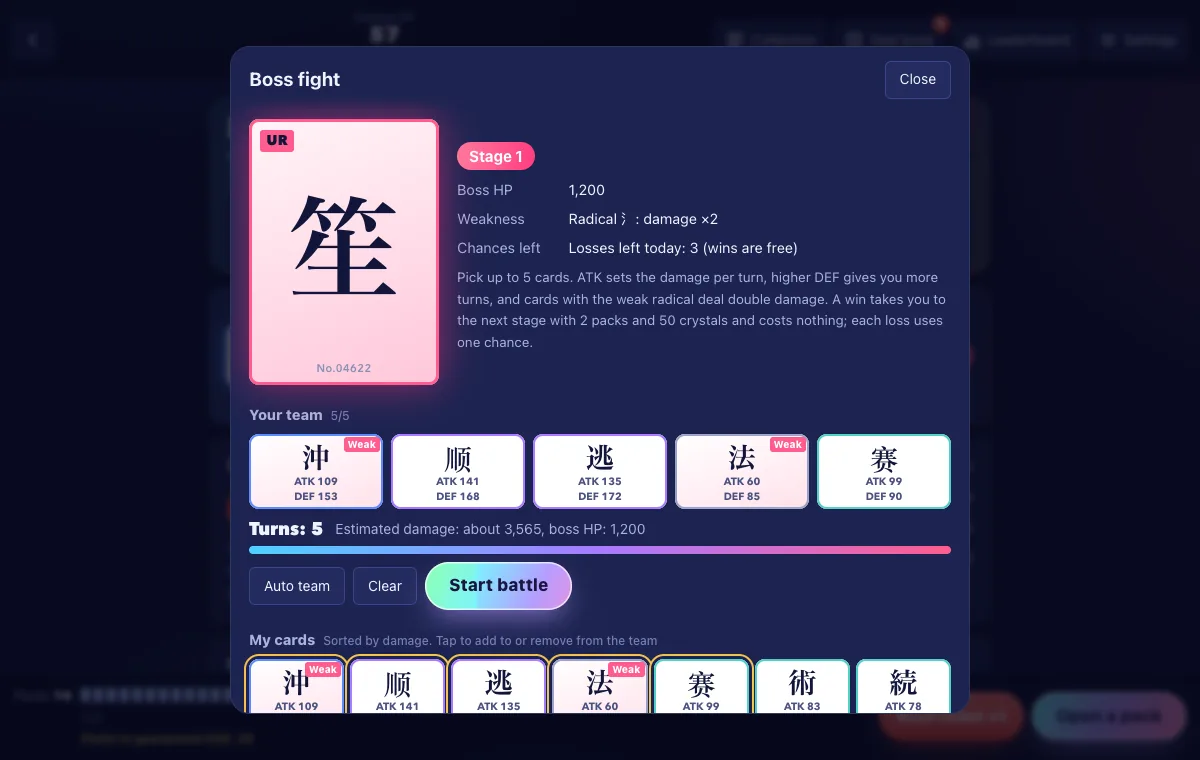
Every day there's a boss: a UR kanji card with HP, an attack and one weak radical. Line up to 5 cards from your Collection. Each card has ATK and DEF. Every turn, your cards hit the boss once each, front to back, then the boss hits your front card. DEF is how much damage a card can take; when it runs out, the card falls and the next one steps up. Cards with the weak radical deal double damage, and sometimes land a critical hit.
So order matters: put high-DEF cards in front to take the hits, and keep high-ATK cards at the back, where they get more turns. A loss doesn't heal the boss. The HP you knock off stays gone for the rest of the day, so your next try picks up where you left off, and a new boss arrives the next day. Win and you move to the next stage, with 50 Crystals, plus a Rush ticket every 5 stages. Wins don't use up a try; you can lose 3 times a day. There's also a daily damage board for the most boss HP knocked off in one fight, no account needed.
The Seal book: 92 achievements, 296 seals
KanjiPack's achievements live in the Seal book. Each one has several thresholds, and every threshold you reach stamps a seal: bronze, silver, gold, jade and star. They come in 12 categories: Collection, Packs, Rush, Luck, Lists, Origins, Radicals, Shapes, Power, Boss fights, Routine, and a few Secrets you only find by stumbling into them.
The Lists category uses real character lists: Japan's jōyō and jinmeiyō kanji, the old JLPT levels 1 to 4, China's Table of General Standard Chinese Characters (levels 1 to 3), and Korea's hanja for education. Open any list to see which characters you're missing, and trade Crystals for them right there.
The Radical atlas lays out all 214 radicals in one chart. Every character you pull lights up its radical, and the more you collect, the brighter it glows. Nearly stamped on the home screen shows the three achievements closest to their next seal.
Leaderboards without an account
The game gives your browser an anonymous identity. Pick a nickname and you're on the boards, no sign-up needed. There are four: the Collection board counts how many different kanji you have, the Seal-points board ranks your Seal book score, Best pack this week tracks your highest KP from a single pack and resets every Monday, and Today’s boss tracks the most boss HP you knock off in a single fight, resetting every day.
A few tips
- Do your daily tasks first. Each one gives 30 Crystals, and finishing all three adds a Rush ticket. They rotate every day: sometimes it's opening packs, sometimes fighting the boss, looking a character up in the dictionary or trading for one.
- Check the boss's weak radical before a fight. One or two cards with that radical make a big difference. Put a high-DEF card in front to shield the rest from the boss's counterattack.
- A Rush ticket starts a Rush straight away. Save it for when you're out of packs, so no refill time goes to waste.
- C and UC characters will come on their own as you open more packs. Your Crystals go further on the SSR-and-up characters you're missing.
- Working on a list or a radical? Open it in the Seal book and the missing characters are listed on their own.
Kanji data, counted on Wikipedia
- What is the rarest kanji?The rarest jōyō kanji is 憬, found in 1,321 of 1.5 million articles. Plus the 84-stroke 𱁬, the 48-stroke 龘, and how often they really appear.
- The 100 most common kanjiThe 100 kanji used most on Japanese Wikipedia, with meanings, readings and the share of articles that use each. Together they make up 39.2% of all kanji.
- How many kanji do you need to read Japanese?Counted across 1.38 billion kanji on Japanese Wikipedia: the 1,000 most common cover 91.9%, the 2,136 jōyō kanji 97.8%. Full table by level.
KanjiPack FAQ
Can I play on my phone?
Yes. It plays fine in portrait mode, and you can tap Fullscreen under the game for a bigger view.
Do I need to download anything or sign up?
No. Just open the page and play. The leaderboards don't need an account either.
Is there a dark mode?
Yes. The button at the top right switches between light and dark, and the game's settings also have Match system.
Is it free?
Yes. There are no paid packs. Packs, Crystals and Rush tickets can't be bought with money or exchanged for money.
Is my progress saved?
Yes, in the browser you're using. Before switching phones or browsers, export your save in Settings and import it on the new device. Clearing your browser data deletes your progress too.
Which languages are supported?
English, Japanese, Simplified Chinese, Traditional Chinese, French, Spanish and Portuguese. Switch the page language at the top of the page, and the game language in the game's settings.
Where do the readings and meanings come from?
Readings and meanings come from open dictionaries such as KANJIDIC2 and Unihan, and character frequency comes from Wikipedia article text. Open any card to see its Mandarin, Cantonese, Japanese on and kun, and Korean readings.
It keeps loading. What can I do?
Refresh the page first. The game downloads its character data the first time, so a slow connection can take a few extra seconds. If it still won't load, try another browser.
Site owner